System LCA – Sewage Treatment Plant (STP) by EcoSTP

Sruthin Vijay
- Published on August 12, 2025
ECOSTP Technologies Pvt Ltd, based in Bengaluru, has developed a decentralised sewage treatment system that requires minimal energy input. The system is designed for use in residential, commercial, and industrial settings. The ECOSTP system is inspired by a cow’s stomach and uses anaerobic bacteria to treat sewage. It functions without electricity, chemicals, or human intervention, relying entirely on gravity flow. This biomimicry-based approach enables decentralised wastewater treatment with minimal resource use.
Monk Spaces conducted a Life Cycle Assessment (LCA) of ECOSTP’s building-level STP—the first such assessment in India. The objective of the assessment was to evaluate the environmental performance of ECOSTP’s plant, which has a 100 kiloliters per day (KLD) capacity.
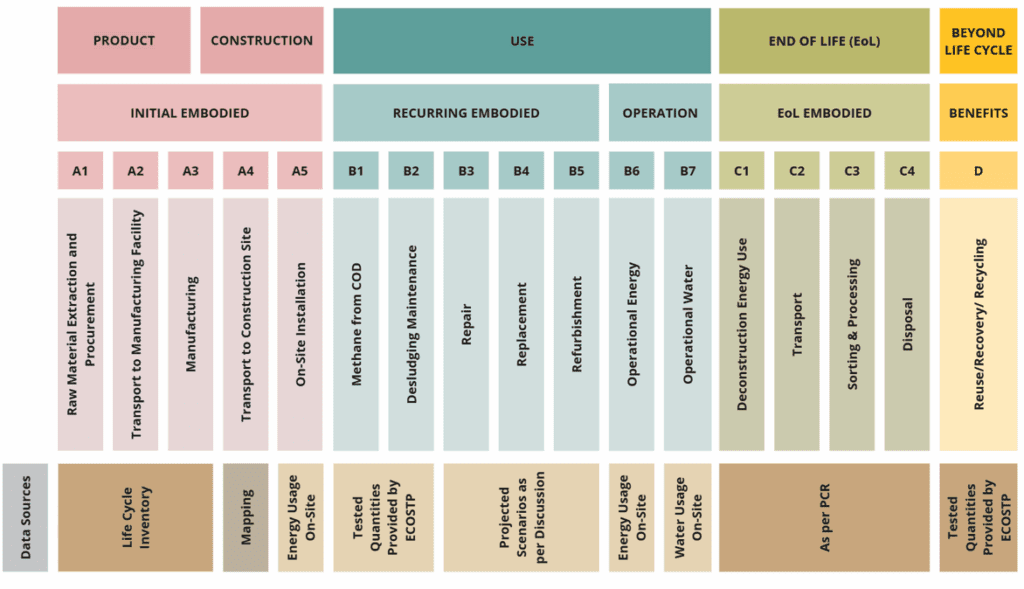
The LCA followed the guidelines of ISO 14040, 14044 and the relevant product category rule (PCR) — PCR 2019:14 – Construction Products – Version 2.0.0. The system boundary modules encompass all life cycle phases, including cradle-to-gate (A1-A3), Construction (A4-A5), Use (B1-B7), End-of-life (C1-C4), and benefits beyond the life cycle (D). These stages align with the mandatory requirements of the identified PCR and manufacturer specifications.
The primary data, including information about raw materials, were collected directly from the ECOSTP team. This included information on construction materials and operational phases. The necessary background data was sourced from the Ecoinvent database and valid global EPDs, ensuring alignment with international environmental data sources. Regional datasets were prioritised over national and global datasets to ensure accuracy and representativeness. The collected data were then used to calculate the environmental impacts of the ECOSTP plant.
The key performance indicator for the assessment is the carbon footprint (GWP-Total) normalised over the total water treated (kgCO₂e/litre). Additionally, the assessment reports the cumulative energy demand (CED) per litre of treated water. CED refers to the total energy used over the system’s life cycle. It is the sum of the resource indicators – renewable energy use (PERT) and non-renewable energy use (PENRT). Other environmental impact indicators were also assessed per the PCR. The study identified the main contributors to environmental impact across different life cycle stages. Recommendations from the study focused on improving the environmental profile of the ECOSTP system. Material substitution was identified as an effective strategy for lowering overall environmental impact. A completeness check, sensitivity analysis, and consistency check were conducted to ensure the reliability and robustness of the data.
Monk Spaces created real-life comparisons for each impact indicator to make the technical results more straightforward to relate to. For instance, the GWP and Acidification Potential (AP) were related to emissions from passenger flights/cars over a certain distance. Similarly, the Eutrophication Potential (EP) was contextualised by comparing it to the emissions from farming over a certain hectare of land. These analogies provided a relatable frame of reference, making the results easier to interpret for diverse audiences.
As part of the study, an estimator tool was also developed to support scalable and simplified assessments. The tool enables users to input basic project variables, including material quantities, concrete, and PVC pipes, among others. Based on these inputs, the estimator provides indicative values for key performance indicators, including GWP-Total, WDP and CED. This enables ECOSTP and its clients to quickly evaluate environmental performance without requiring a full LCA for each project.
This LCA represents a significant step forward for ECOSTP in terms of environmental transparency and responsible design. By voluntarily undertaking the study, the company sets a precedent for the Indian wastewater sector. It reinforces ECOSTP’s leadership in offering sustainable, decentralised solutions for urban infrastructure.